


Meteor Crater
page 2
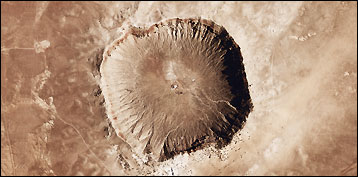
Meteor Crater
recent history
in brief
 Daniel Barringer
In the first half of the 20th century, mining engineer Daniel Barringer dug and drilled deep shafts into the crater floor to find the large remnant of the meteor so he could sell the metal. He failed in his mission, but some people call the geological formation "Barringer Crater" – and the shafts and some of his work buildings and construction gear remain in place today.
Eugene Shoemaker
Until about a half-century ago, the science community thought that Meteor Crater was volcanic, not meteoritic in origin. Then, astro-scientist Eugene Shoemaker successfully argued that it could only have been created by a powerful meteor impact because of two rare silica minerals found at the location.
Computer
simulations
In 2005, scientists announced that computer simulations showed that the meteor fragmented and broke into pieces 14 meters (9 miles) before it hit the ground. And, the largest piece (which amounted to about half the original mass) was not traveling fast enough to melt appreciably its iron-nickel composition. That solved the century-old mystery of why large chunks of the fused metal normally associated with meteorites were never found.
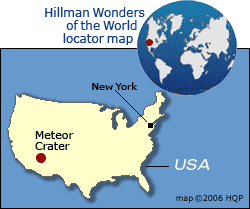
Location in America
Learn More
 for Meteor Crater - Page 1
Learn my other
America tips & insights
America Wonders - Complete list
America wonder map
Top 10 Famous American foods
NASA satellite photo - PD


World's Top 100 Wonders
World's Top 1000 Wonders
Site map
My credentials
About my website and criteria
Reader testimonials