

![]()
![]()
![]()
Grand Canyon
Meteor Crater
Monument Valley
Sedona Red Rock Country
Alcatraz Island
Monterey Aquarium
Redwoods National Park
San Diego Zoo
San Francisco
San Francisco Cable Cars
Sequoia National Park
17-Mile-Drive
Yosemite National Park
Kennedy Space Center
Walt Disney World
Hawaii Volcanos National Park
Na Pali Coast
Waimea Canyon
American Museum Natural History
Guggenheim Museum
Metropolitan Museum of Art
Museum of Modern Art
New York Skyline View
Niagara Falls
(with Canada)
Statue of Liberty
Times Square at Night
United Nations
Bryce Canyon
Zion National Park
National Gallery Arts
Smithsonian
Devils Tower
Grand Tetons
Yellowstone National Park
Alaska Cruise
Alaska
Bayous Louisiana
Carlsbad Caverns
New Mexico
Las Vegas Strip at Night
Nevada
Mammoth Caves
Kentucky
Mesa Verde Colorado
Mt Rushmore South
Dakota
America wonder
map
America home page
American cuisine
Site map
About me and my credentials
About my website
Reader testimonials
Email me your opinion


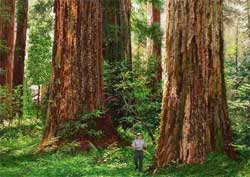
The redwoods are the world's tallest trees, and many of the highest ones reside in the Redwoods National Park in northern California. Some are 30-stories high and have lived for 2,000 years.
The redwood bark is extra thick, which helps protect the plant during forest fires. The bark is also high in tannin, which insects hate. And, the tree self-sheds all but the branches high off the ground, which also thwarts insect attack. All these factors contribute to the organism's remarkable multi-millennial longevity.
The bark is more auburn than red, but inside, the color becomes redder. This gives the tree its name.
The roots are unexpectedly shallow for such a towering life form. They rarely go deeper than 3 meters (10 feet). Instead, they broadly spread out. And, they tangle with the roots of other redwoods, which creates structural reinforcement. The need to do this is one reason why redwoods grow close together.
The leaves are designed to capture and condense moisture from the coastal fog during the dry season. Soon the droplets fall to the ground like rainfall to water the roots of the thirsty tree.
Redwoods can reproduce from seed - or by sprouting, from either live or dead trees.
The urge to conserve began in the 1800s when logging cut down most of the redwoods (its durable wood is excellent for constructing buildings).
The Redwood and Sequoia National Parks, both Hillman Silver Medal winners, are located 800 kilometers (500 miles) apart. Their majestic trees are biologically close relatives, but have distinct characteristics. The redwoods are slightly taller, and have a fluted bark pattern. The sequoias are greater in girth and volume, have a motley bark pattern, and live longer.


sponsored ad

Explore my
candid country, region
and other travel guides
Click links for tips & insights
WONDERS OF ... | WONDERS OF ... | CRUISE GUIDES | WORLD'S TOP WONDERS | OTHER TIPS & INSIGHTS |
|
| |||
SPECIAL TOPICS | MORE | |||
|
| |||
|
| |||
|
|
| ||
|
|
| ||
|
|
| ||
|
|
|
|