

Share with your friends

Beijing & environs wonders

Forbidden City
Great Wall of China
Lama Temple
Summer Palace
Temple of Heaven
Tiananmen Square

Hong Kong & environs

Hong Kong Harbor/Cityscape
Hong Kong Restaurants & Shops
Tian Tan Buddha Po Lin

Shanghai & environs

Bund River Front
Jade Buddha Temple
Pudong/Shanghai Skylines
Shanghai Museum
Shanghai Old City

Shaanxi

Qin Terra Cotta Warriors
Wild Goose Pagodas
Xi'an City Walls

Sichuan & Chongqing

Dazu Rock Carvings
Jiuzhaigou
Leshan Great Buddha
Shibaozhai Temple
Yangtze River Cruise

Tibet

Ganden Monastery
Jokhang Temple
Mount Everest  with Nepal
Potala Palace of Lhasa
Sera Monastery
Tashilumpo Monastery

Yunnan

Baishui Terrace
Lijiang & Shangri-La
Stone Forest
Three Pagodas
Tiger Leaping Gorge
Xishuangbanna
Yuan Yang Rice Terraces

Wonders in other China regions

Chengde Mountain Resort
Hanging Monastery
Huangshan Mountain Range
Jiayuguan Fort
Kaifeng Historical Sites
Labrang Monastery
Li River Cruise
Long Ji Rice Terraces
Longmen Caves
Mogao Caves
Mount Taishan
Pingyao Ancient City
Reed Flute Cave
Sanjiang Bridges
Shenyang Imperial Palace
Shouxi Lake
Silk Road
Suzhou Gardens & Canals
Three Gorges Dam
West Lake
Wudang Ancient Complex
Wulingyuan Scenic Areas
Yangshou
Yungang Caves

My other China pages

China wonder map
China home page
Chinese phrases
Chinese cuisine

World wonders

Top 100
Top 1000

More

Site map
About me and my credentials
About my website
Reader testimonials
Email me your opinion


Chinese phrases

with pronunciations

Mandarin Chinese
phrase sheet

China has many languages and dialects. Mandarin is the most widely used and is considered the national spoken language.


Tone pronunciation

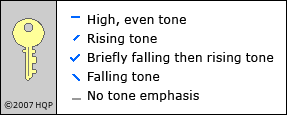
Mandarin Chinese uses 4 tones to differentiate words (see key below). Using them is essential for avoiding misunderstandings. For example, the world "ma" has four distinct meanings, depending on the tone you use.

Ma =  Mother

Ma =  Linen/hemp

Ma =  Horse

Ma =  To curse

You wouldn't want to call someone's mother as a horse.


I inserted symbols (such as ) after each syllable in the phonetics below. You will not see those symbols in transliterations written on signs, menus and other media. I use them as visual aids to help you pronounce a syllable with the correct tone (also called pitch or inflection).


Hello
ni hao
  kneehow


Goodbye
zaijian
  zyejeeahn


Thank you
xie xie ni
  shehshehknee


You're welcome
bu ke qi
  bookehchee


Please
qing
  cheeng


Excuse me
dui bu qi
  dwayboochee


My name is...
wo jiao
  wahjao("a" as in "father")


How much?
duo shao
  dahshao (rhymes with "cow")


I don't understand
wo bu dong
  wahboodohng


Yes
shi
  she


No
bu shi
  booshe


One
yi
  yee


Two
er
  ehr


Three
san  sahn


Mandarin Chinese
insights

Mandarin is the spoken language of Beijing and surrounding areas.
It is difficult for foreigners to speak because it is a tonal language.
The words in black non-bold type in the glossary above are the Pinyin spelling ("ni hao" for instance). It converts Chinese characters into Roman letters. The system was created for the benefit of non-Chinese speaking foreigners.
Some of the street and other signs in big cities use Pinyin in small type under the Chinese characters.
Print this page to take with you on your next trip to China.

Wonders of China

Wonders of China - Locator map

World's Top 100 Wonders

World's Top 1000 Wonders


CNTO


sponsored ad 

Explore my
candid country, region
and other travel guides

Click links for tips & insights


©2012 HQP - Hillman Quality Publications / hillmanwonders.com

share