

![]()
![]()
Forbidden City
Great Wall of China
Lama Temple
Summer Palace
Temple of Heaven
Tiananmen Square
Hong Kong Harbor/Cityscape
Hong Kong Restaurants & Shops
Tian Tan Buddha Po Lin
Bund River Front
Jade Buddha Temple
Pudong/Shanghai Skyline
Shanghai Museum
Shanghai Old City
Qin Terra Cotta Warriors
Wild Goose Pagodas
Xi'an City Walls
Dazu Rock Carvings
Jiuzhaigou
Leshan Great Buddha
Shibaozhai Temple
Yangtze River Cruise
Ganden Monastery
Jokhang Temple
Mount Everest with
Nepal
Potala Palace of Lhasa
Sera Monastery
Tashilumpo Monastery
Baishui Terrace
Lijiang & Shangri-La
Stone Forest
Three Pagodas
Tiger Leaping Gorge
Xishuangbanna
Yuan Yang Rice Terraces
Chengde Mountain Resort
Hanging Monastery
Huangshan Mountain Range
Jiayuguan Fort
Kaifeng Historical Sites
Labrang Monastery
Li River Cruise
Long Ji Rice Terraces
Longmen Caves
Mogao Caves
Mount Taishan
Pingyao Ancient City
Reed Flute Cave
Sanjiang Bridges
Shenyang Imperial Palace
Shouxi Lake
Silk Road
Suzhou Gardens & Canals
Three Gorges Dam
West Lake
Wudang Ancient Complex
Wulingyuan Scenic Areas
Yangshou
Yungang Caves
China wonder map
China home page
Chinese phrases
Chinese cuisine
Site map
About me and my credentials
About my website
Reader testimonials
Email me your opinion


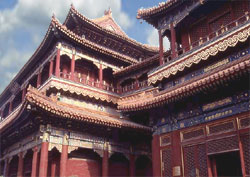
The Lama Temple in Beijing is the largest and best preserved lamasery in the world outside of Tibet. The building complex covers a large area - it stretches back almost 500 meters (1600 feet) from the front gate.
The Lama Temple has five major halls, each fronted by its own courtyard bustling with activity. Architecturally, the halls enjoy traditional styling imbued with bright hued structural details and elaborately upturned eaves.
The most striking element of the Lama Temple is the 23 meter (75 foot) high statue of the standing Buddha. It resides in the rear and tallest hall - and was carved from the trunk of a single sandalwood tree.
Another hall is home to three large bronze statues of the seated Buddha. They depict Buddha in his three classic states: past, present and future.
You experience a working lamasery, not a museum ambience. The daily scene is infused with dozens of monks and hundreds of devotees praying and burning incense sticks.
Though the Lama Temple was founded and is today considered a Tibetan Buddhist lamasery, many of the monks come from Mongolia.
The buildings were first constructed in 1694 during the Qing Dynasty. Originally, the site was the residence of the Emperor Yongzheng when he was still a prince. The site was eventually converted into a lamasery.
The Lama Temple is also known by various names including Yonghe Lamasery, Yonghegong, and the Palace of Peace and Harmony.
Lama: lah-mah

sponsored ad

Explore my
candid country, region
and other travel guides
Click links for tips & insights
NATION / REGION |
| CRUISE GUIDES | SPECIAL TOPICS | OTHER TIPS & INSIGHTS |
| ||||
| MORE | ||||
|
| |||
|
|
| ||
|
|
|
|