

![]()
![]()
Forbidden City
Great Wall of China
Lama Temple
Summer Palace
Temple of Heaven
Tiananmen Square
Hong Kong Harbor/Cityscape
Hong Kong Restaurants & Shops
Tian Tan Buddha Po Lin
Bund River Front
Jade Buddha Temple
Pudong/Shanghai Skyline
Shanghai Museum
Shanghai Old City
Qin Terra Cotta Warriors
Wild Goose Pagodas
Xi'an City Walls
Dazu Rock Carvings
Jiuzhaigou
Leshan Great Buddha
Shibaozhai Temple
Yangtze River Cruise
Ganden Monastery
Jokhang Temple
Mount Everest with
Nepal
Potala Palace of Lhasa
Sera Monastery
Tashilumpo Monastery
Baishui Terrace
Lijiang & Shangri-La
Stone Forest
Three Pagodas
Tiger Leaping Gorge
Xishuangbanna
Yuan Yang Rice Terraces
Chengde Mountain Resort
Hanging Monastery
Huangshan Mountain Range
Jiayuguan Fort
Kaifeng Historical Sites
Labrang Monastery
Li River Cruise
Long Ji Rice Terraces
Longmen Caves
Mogao Caves
Mount Taishan
Pingyao Ancient City
Reed Flute Cave
Sanjiang Bridges
Shenyang Imperial Palace
Shouxi Lake
Silk Road
Suzhou Gardens & Canals
Three Gorges Dam
West Lake
Wudang Ancient Complex
Wulingyuan Scenic Areas
Yangshou
Yungang Caves
China wonder map
China home page
Chinese phrases
Chinese cuisine
Site map
About me and my credentials
About my website
Reader testimonials
Email me your opinion


China has more caves than any other nation. Most travelers consider the Reed Flute Cave (situated just outside the city of Guilin) to be the most interesting.
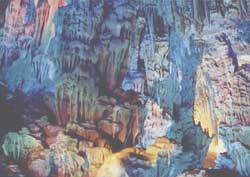
Reed Flute Cave has remarkable stalactites, stalagmites and other rock formations in a myriad of fanciful shapes.
However, I believe some tour guides overly focus on what the formations resemble (birds, animals, flowers, what have you) at the expense of focusing on the beauty of the formations and explaining how they evolved. Taking the "use your imagination" approach is good, but it can be overdone.
Another issue: Many formations are overly illuminated with multi-colored lights, which mask and distract from the cave's natural beauty.
This pool enchants (unless a previous visitor has made ripples by mindlessly waving his hand in the pool's water).
The Reed Flute Cave was created by an ancient underground river, which slowly eroded the interior of the limestone mountain.
The cave was popular with tourists and poets about 1300 years ago during the Tang Dynasty. Some wrote inscriptions on the cave walls, which can be seen today.
Reed Flute Cave is large enough to hold over a thousand people at one time. Its space was used as an air raid shelter during the Second World War.
Reed Flute can be crowded, with the voice of guides discordantly blaring on handheld megaphones. I recommend entering Reed Flute Cave when it first opens in the morning, before the tour groups arrive. This way, you can enjoy Reed Flute Cave in its irresistible mode, silent and serene.
Wear shoes with good traction because some steps inside a cave can be a bit wet and slippery. Bring a sweater if a damp, 20C (68F) cave environment would make you feel uncomfortably cold. You will be in the cave for about one hour.
The name "Reed Flute" came about because reeds that are used for making flutes grew at the cave's entrance.
For fewer fellow cave tourists, visit the worthy Seven Star Cave (also near Guilin). The visitor's route inside Reed Flute Cave is 240 meters (800 feet). The one inside Seven Star cave is longer.
Guilin is in Guangxi province and lies roughly 1000 kilometers (600 miles) northwest of Hong Kong and Guangzhou (Canton), the capital of Guangdong province.

sponsored ad

Explore my
candid country, region
and other travel guides
Click links for tips & insights
NATION / REGION |
| CRUISE GUIDES | SPECIAL TOPICS | OTHER TIPS & INSIGHTS |
| ||||
| MORE | ||||
| ||||
| ||||
|
| |||
|
|
| ||
|
|
|
|