
|

an impartial
Vatican City Guide by
a travel authority
Travel
wonders of
the Vatican City


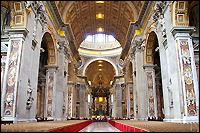
St. Peter's Basilica
Artistically and
architecturally, the Basilica of St. Peter's is a masterpiece. It is the central church to 500 million Roman Catholics.


Sistine Chapel
This relatively large chapel houses Michelangelo's world famous frescos: "Genesis" and "The Last
Judgment". The Sistine Chapel is also renowned as being the venue where popes are chosen.


Vatican Museums
The sprawling network of galleries collectively called the Vatican Museums is home
to many artwork masterpieces and historical documents, including from ancient
Egypt and the Renaissance. One room (the Sistine Chapel) wins my gold medal.


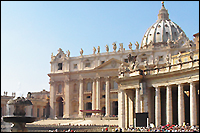
St. Peter's Square
This immense o
pen space is the public entranceway to the Vatican City - and is
sometimes packed with a half million people. St. Peter's Square is impressively
flanked by Bernini's 17th century classical colonnades - and is centered by an Egyptian obelisk.

Vatican City
tips & insights

Late Spring and early Fall are the
best times to visit. The weather is pleasant and the Vatican City is not overwhelmed with tour groups.

Avoid crowds by visiting the
Vatican City (and especially its Sistine Chapel) when doors first open in the morning.

Expect thick crowds throughout the
day during the Easter and Christmas periods - and during pontifical blessings, funerals and elections.

The Vatican City (also called the
Holy See) is the ecclesiastical and administrative seat of the Roman Catholic Church. It has nearly a billion
followers around the world.

It is a relatively small enclave
lying inside the city limits of Rome, but is an independent state.

The Vatican City is the smallest
independent nation state in the world in area and population. It is also the richest state on a per capita
and per square area basis.

It issues its own postal stamps
and has a newspaper.

The Vatican partially sits on a
hill that the Romans called Vaticanus. That's how it derived its name.

For 455 years (1523-1978) all
the popes were Italian. That string was broken when a Pole, John Paul II, became pope. And, his successor, the
current pope, Benedict XVI, is German.


|