


British Museum
Travel tips you can trust

Why the
British Museum
is special
The British Museum in London, England exhibits a wealth of cultural masterpieces including famous antiquities and historic documents.
The British Museum is one of the world's most popular museums - it attracts about six million visitors per year. The three most celebrated crowd-pullers are the:
 Elgin Marbles
Rosetta Stone
Great Court
Elgin Marbles
 Their original home
These ancient Greek sculptures once adorned the Parthenon in Athens. In the nineteenth century, Lord Elgin shipped them to England.
Controversy
The Elgin Marbles have embroiled the British Museum in a growing controversy. A number of individuals and cultural organizations argue that the museum should return these artistic masterpieces to Greece because Lord Elgin "stole" them (that is, he took them without obtaining proper approvals from the Greek government and people).
Rosetta Stone
Hieroglyphics
decoder
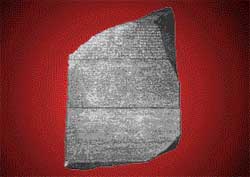
The 2200-year-old Rosetta Stone (see photo above) stands only one meter high but is of towering significance. Its discovery in 1799 enabled archaeologists to decipher the hieroglyphics chiseled on ancient Egyptian temples. This was possible because an identical message is repeated on the Rosetta Stone using three different written languages. One of them is hieroglyphics. Because the archaeologists knew the other two, they learned how to interpret hieroglyphics.
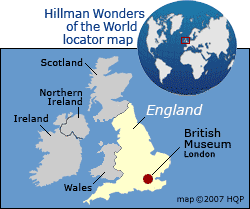
Location in England
Learn More
 for British Museum tips - Page 2
Learn my other
England tips and insights
Wonders of England - Top 10 rankings
England Wonders - Map
English Cuisine


World's Top 100 Wonders
World's Top 1000 Wonders
Site map
My credentials
About my website and criteria
Reader testimonials