


Coliseum of Rome
interesting tidbits
Italy
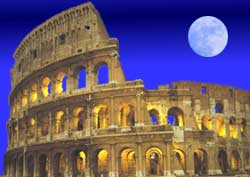

Coliseum of Rome
conversation pieces
 Spectators sometimes
became part of
the Coliseum show
Although the typical Coliseum of Rome combatants were trained gladiators, convicted criminals and prisoners of war, occasionally glory-seeking individuals volunteered to fight. Often they overrated their skills and suffered the consequences.
Unsuspecting
spectators
At least one emperor ordered his guards to toss unsuspecting spectators into the arena, for various reasons. The victim may have previously angered the emperor. Or, the victim may have been a complete stranger but the emperor disliked the way he was behaving in the Coliseum of Rome. Sometimes the emperor's motive was simply to amuse himself by randomly selecting a spectator to meet his death in the arena.
One emperor participated
Commodus was the only emperor to fight in the Coliseum of Rome, which he did many times. He killed but was never killed. His matches were rigged by selecting opponents who were under-armed, poorly skilled or physically impaired from previous fights). He is the person portrayed as the malicious emperor in the Academy Award winning movie, Gladiator.
Audience segregation
Spectators were seated in the Coliseum of Rome by rank, social class and gender. The emperor had his own "court side" box. Senators were allocated choice ringside seats. The rich & well-connected had the next best seats. Male commoners (the largest audience segment) sat behind them. Woman were relegated to the upmost tier – except for those trying to survive in the arena.
Not every gladiatorial
combat was a fight
until death affair
A gladiator was a valuable asset to his owner. Understandably, the owner tried to keep his gladiators alive as long as possible because training a replacement was an expensive endeavor. The owner was usually reluctant to enter a gladiator in combat unless the chances of him surviving were high (even if he lost the fight). The Coliseum of Rome event organizers recognized that they had to keep the death rate down if they were to have enough gladiators show up (but not too low lest the spectators stayed home).
Fighting categories
Gladiators were specialized in the Coliseum of Rome.
 One type was armed with a short, heavy sword and
wore a hefty wrap-around helmet plus protective arm and leg guards. Brute strength was his forte. This
is the gladiator class that has become the movie cliché image of the bad-guy.
One type was armed with a short, heavy sword and
wore a hefty wrap-around helmet plus protective arm and leg guards. Brute strength was his forte. This
is the gladiator class that has become the movie cliché image of the bad-guy.
Another
major category had limited armor and relied on
cunning and quickness (think of Hollywood's hero).
He was protected only by a light sword and a small
arm-band shield.
Yet another gladiator type fought with nothing
but a trident and a net for ensnaring a foe.
A Coliseum of Rome gladiator could be matched against an opponent within or outside his category.
Some gladiators
gained freedom
If a gladiator earned a reputation for fighting well and bravely in the Coliseum of Rome, the roaring crowd would implore the emperor that he be liberated. If the request was granted, the gladiator was handed a wooden sword, signifying that he was a free man and would never have to fight again.
Wide variety
of wild beasts
About the animals
Types of animals
The managers of the Coliseum of Rome imported animals to fight from as far away as Africa and India. The wild beasts included fierce lions, tigers, leopards, elephants, hippos and rhinos.
Where they resided
The animals were kept in cages and cells directly underneath the wooden floor where the combats occurred. Because the wooden floor no longer exists, the network of underground rooms and corridors is now visible to Coliseum of Rome visitors.
Trap doors
To add excitement to the spectacles, trap doors were strategically hidden locations in the wooden floor. Suddenly, one would spring open, releasing a charging lion or other savage animal, ready to attack anyone who happened to be in the Coliseum of Rome arena. The crowds loved this gimmick.
Why the Coliseum of
Rome is not on the famous
Ancient Seven Wonders list
The Ancient Wonders of the World list was composed in the 3rd century BC, roughly 200 years before the Coliseum of Rome was built. Had it then existed, the Coliseum of Rome would probably have made the list.
The link below takes you to my Seven Wonders of the Ancient World web page. It includes pictures and descriptions plus my analysis of the strengths and weaknesses of the ancient list.
Coliseum's original name
During the days of the Roman Empire, the Coliseum of Rome was called the Flavian Amphitheatre (after the emperor dynasty that built it). Eventually, people nicknamed it the Coliseum, which derives from a Roman word for gigantic. Language sleuths are not sure whether the Romans were referring to the immense scale of the Coliseum of Rome or to the fact that it stood near the colossus ("tall statue") of Nero.
The Coliseum of Rome
was not unique
The Romans built numerous other amphitheaters around their far-flung empire – and the one in Nimes, France is in better physical shape than the Coliseum of Rome. What makes the latter superlative is its unrivaled size and historical background.
Lord Byron's famous lines
The renowned 19th century English poet Lord Byron penned this prophecy regarding the Coliseum in his Childe Harold's Pilgrimage composition:
While stands the Coliseum,
Rome shall stand;
When falls the Coliseum,
Rome shall fall;
And when Rome falls
- the World.
The Coliseum's vast awning
The Coliseum of Rome could shelter spectators and participants with an immense awning on drizzling and sizzling sunny summer days.
The huge awning covered
the top of the Coliseum. The task of
mounting and removing it was challenging.
No one knows for certain how it was done.
Some experts believe that the awning
may have been a single massive piece. When needed, it was first spread out on the Coliseum
of Rome's floor and lower seats. It was then slowly hoisted to the top and
secured to the vertical flag poles that once
circled the building's upper rim.
Other experts think that the
awning may have consisted of individual sail-like triangular sheets.
These canvas segments were supported by mast-like poles that jutted out teepee-style
from the Coliseum of Rome's upper rim. Ropes extended and retracted the horizontal
sails, boat-style.
Click
the "Coliseum of Rome - Main Page" menu link to see my animated picture of
how the Coliseum of Rome originally appeared, with and without its canvas covering.
Click blue links below
to learn more about the
Colosseum of Rome
Coliseum of Rome - Main page
Colosseum
history in brief
Read my other Italy pages
Wonders of Italy - Complete list
Italy wonder map
Basic Italian phrases
Italian cuisine
Best time to visit Rome


World's Top 100 Wonders
World's Top 1000 Wonders
Site map
My credentials
About my website and criteria
Reader testimonials