

|

Why Machu Picchu
is special
Most
seasoned travelers agree that Machu Picchu is the world's most dramatic ruins.
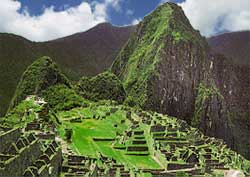
It sits boldly perched on a steep sided mountain saddle far above the partially encircling
Urubamba River gorge.
What remains of the precision stonework of the pre-Colombian Inca temples and palaces clearly reveals
how exalted Machu Picchu was in its glory days.

The Lost City
of the Incas

Just before the Spanish conquest, Machu Picchu was mysteriously abandoned
- and this was when it was still in
its golden age. It subsequently lay buried under dense mountainous vegetation until 1911 when Yale
explorer Hiram Bingham discovered it and began the reclamation process.

Experts debate
Machu Picchu's purpose

Archaeologists disagree on whether Machu Picchu was primarily a citadel, religious site or royal retreat. For decades the prevailing beliefs have been that
it was principally either an Inca military
stronghold or a religious center - or a combination of both.

Although there is scant evidence that Machu Picchu was an important sacred site, the stronghold theory
bears weight because the builders chose an enviable defensive setting bordered on three sides by precipitous
river canyon walls. Moreover, the inhabitants could survive a long siege. They were
self-sufficient regarding food because they farmed and ranched the verdant Machu Picchu terraces.

Still, the citadel theory has a weakness. Would there be sufficient military value to justify constructing a major
citadel in Machu Picchu's remote location?

Recently two archaeologists threw a monkey wrench into the
stronghold vs. sacred site dispute. Their research suggests that Machu Picchu was built mainly as a
spectacular summer mountain palace. If so, the designers knew what they were doing.

Getting to
Machu Picchu

Nearly
all tourists reach Machu Picchu by flying from Lima to the city of Cuzco (1
hour 15 minutes), staying overnight, then catching an early morning train to a
village at the base of the ruins (several hours). They then transfer to a bus
that zig-zags up a steep 2,000 foot high mountain slope to reach the Macchu
Picchu site (30 minutes).

You
can also hike from the Cuzco area to Macchu Picchu on a network of ancient
paths collectively named the Inca (or Inka) Trail. The journey takes 2 to 10
days, depending on your speed and choice of paths.

Helicopter service
between Cuzco and Machu Picchu is now once again available.

Machu Picchu
tips & insights

My
Hillman Wonders of the World list officially began in earnest in 1968 at Machu Picchu. Read the
"About Me & My Website" web page for more details.

The
best months for visiting are May to September. May is the prettiest month (the
dense, subtropical mountain forests are exceptionally green) while August is the
best all around month. The least desirable period is from October to April, the
rainy season.

Most
travelers take a day trip to Machu Picchu (they take the mid afternoon train
back to their hotels in Cuzco). This leaves just about two hours at the site - and part of that precious time is expended by having lunch at the
hotel. You'll have more hours to enjoy and explore the ruins if you stay
overnight at the hotel at the site. You will be able to explore this travel
wonder in
the late afternoon and early the next morning when the tourist count is low.
Rooms are scarce, so book well ahead.

The
huge granite stone building blocks were hewn so precisely that
they fit tightly together by themselves. No mortar or other adhesive was used.
You cannot even insert a thin blade between their joints.

You can climb
Huayna Picchu, the sharp peak immediately behind the ruins (see photo). The
reward is a spectacular view of Machu Picchu below you. However, be fit and sure
footed as the ancient stone steps to the top are steep and primitive. If you do
climb the peak, avoid inclement weather as the stones could be slippery. And, in
2004, a visitor was struck by lightning when he reached the summit.

The
conquering Spanish did not know of Machu Picchu because its existence was known
only by local insiders.


View my other top 100
Wonders of the World
 
|