


Marienbad
Travel tips you can trust
Why
Marienbad
is special
From the early 1800s through the late 1920s, Marienbad was one of the world's most exclusive thermal spring spas. It attracted royalty and aristocrats plus titans of music and literature. Although Marienbad gradually fell into disrepair in the ensuing years, many of its pastel-hued Baroque buildings have been restored in the last couple of decades.
Marienbad
tips and insights
 Setting
Marienbad sits in a pleasant valley surrounded on three sides by pine forested hills. Several dozen mineral springs dot the area. They are warmed by subterranean volcanic activity.
Spas
The local mineral spring waters help cure a long list of diseases (say the spa operators). Some charming old fashioned spa hotels are still around (Nove Lazne is the most famous). Spa treatments are available, including thermal, mud, and carbon dioxide gas baths.
Colonnade
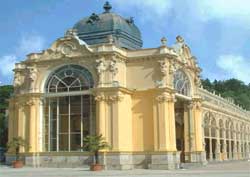
Visitors come to the main colonnade (see photo) to drink the mineral water out of a small, spouted porcelain cup used exclusively for that liquid.
Learn More
 for next Marienbad page
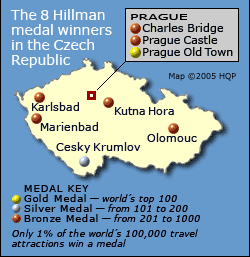
Czech Wonder
location map
Know these
Czech tips and insights
Czeck Wonders
Cesky Krumlov
Charles Bridge
Karlsbad
Kutna Hora
Marienbad
Olomouc
Prague Castle
Prague Old Town
Other Czech pages
Top 10 Czech Wonder rankings
Basic Czech phrases
Czech cuisine
Czech honorable mentions
Famous festivals
Czech Republic fact sheet
Photo gallery


World's Top 100 Wonders
World's Top 1000 Wonders
Site map
My credentials
About my website and criteria
Reader testimonials