


Great Sphinx
Travel tips you can trust

Why the
Great Sphinx
in Giza, Egypt
is special
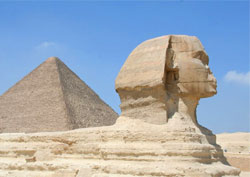
The Sphinx has one of the world's most recognized faces and has been - along with its neighboring Pyramids - an icon of Egypt for thousands of years. Yet, no one knows for certain when it was built - and why and by whom.
Great Sphinx
tips and insights
 Physical
description
Physical
description
The Sphinx has the body of a lion and the head of a pharaoh or god. It's in a relaxed crouching position with outstretched legs.
 Material
It was sculpted out of a large, monolithic limestone outcropping.
Size
It measures 20 meters (65 feet) in height and 73 meters (240 feet) in length.
Age
Most experts date it to Pharaoh Khafra's reign (26th century BC). Some believe the Sphinx was sculpted much earlier. Others argue later.
Missing nose
Theories abound. They include destruction by an irate religious zealot and, less likely, by Napoleonic or Turkish military canon fire.
Burried in sand
For most of its multi-thousand-year lifespan, the Sphinx has been shrouded in wind-driven desert sand, sometimes up to its shoulders. Major sand clearing projects occurred at various times. The last was in the early 20th century.
Recent damage
An ill-advised restoration in the 1980s caused structural deterioration. The current major threat is acute smog from nearby Cairo.
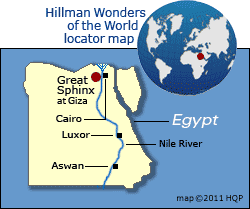
Location in Egypt
Read about each of Egypt's top 7
 Pyramids of Egypt at Giza
 Karnak Temple
 Nile River Cruise
 Egyptian Museum
 Valley of the Kings
 Abu Simbel
 Luxor Temple
Photo by Nina Hale - CC BY 2.0


World's Top 100 Wonders
World's Top 1000 Wonders
Site map
My credentials
About my website and criteria
Reader testimonials