

![]()
![]()
Acropolis/Parthenon
Alhambra
Amalfi Drive
British Museum
Canals of Venice
Cappadocia
Chambord Chateau
Chartres Cathedral
Colosseum of Rome
Delphi
Dubrovnik
Eiffel Tower
Fjords of Norway
Florence Cityscape
Hagia Sophia
Hermitage Museum
Kremlin
Leaning Tower of Pisa
Louvre Museum
Matterhorn
Mezquita of Cordoba
Mont-St-Michel
Neuschwanstein Castle
Pompeii
Portofino
Prague Old Town
Santorini
Sistine Chapel
St. Basil's Cathedral
St. Mark's Basilica
St. Peter's Basilica
Stonehenge
Topkapi Palace
Uffizi Gallery
Versailles
Angkor Wat
Bagan Temples & Pagodas
Bali
Banaue Rice Terraces
Borobudur
Forbidden City
Golden Pavilion
Golden Temple
Great Wall of China
Hong Kong Harbour/City
Kashmir Valley
Katmandu Valley
Ladakh
Li River Cruise
Lijiang Shargri-La
Meenakshi
Mt. Everest
Potala Palace at Lhasa
Qin Terra Cotta Warriors
Shwedagon Stupa
Taj Mahal
Temple Emerald Buddha
Varanasi/Ganges
Yangtze River Cruise
Abu Simbel
Baalbek
Burj Al Arab
Burj Khalifa
Damascus Old City
Egyptian Museum
Jerusalem Old City
Karnak Temple
Marrakesh
Mecca
Nile River Cruise
Ngorongoro Crater
Petra
Pyramids of Egypt
Sahara Desert
Serengeti Migration
Valley of the Kings
Victoria Falls
Banff National Park
Carlsbad Caverns
Chichen Itza
Grand Canyon
Metropolitan Museum
New York Skyline
Niagara Falls
San Francisco Bay/City
Teotihuacan
Yellowstone
Yosemite
Amazon Rain Forest
Angel Falls
Carnival in Rio
Easter Island
Galapagos Islands
Iguazu Falls
Machu Picchu
Rio Panoramic Views
Antarctica Cruise
Ayers Rock
Bora Bora
Great Barrier Reef
Site map
About me and my credentials
About my website
Reader testimonials
Email me your opinion


The Pyramids of Egypt are far bigger than most people would imagine. They are even more amazing when we consider that they were built nearly 4600 years ago.
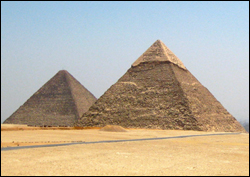
The animated picture above illustrates the marked difference in appearance between the way the Pyramids of Egypt looked originally and look today.
When built, they were covered with a smooth limestone surfacing that gave them a sleek finished look.
Today they have a rugged exterior because subsequent ancient rulers filched the surface stones from the monuments for use on their own buildings.
Khufu's edifice is the farthest of the three great Pyramids of Egypt in the animated picture. It seems shorter than the middle pyramid (Chephren's) for two reasons. First, Chephren's sits higher on the plateau than Khufu's. Second, this vantage point (popular with photographers) makes Khufu's appear smaller because it is more distant.
His structure is the oldest, biggest and most famous of the great Pyramids of Egypt.
Pharaoh Khufu's pyramid was built during his reign, 2589 to 2566 BC.
The mummies in all three tombs were removed long ago by sophisticated tomb robbers. They also took priceless buried treasure.
Pharaoh Khufu's pyramid is the only true surviving member of the famous olden list. Click my round blue "Ancient seven wonders" button in the right column to read my 8-page section on that list. It is based on my firsthand research at all seven locations.
Many theories exist on how the Pyramids of Egypt were constructed. Most Egyptologists now believe that a large temporary earth ramp with a gentle incline was built. The giant stone blocks were then dragged up the slope with a combination of pulleys, levers and raw manpower.
Over the course of several centuries, the construction design evolved from the modestly high step pyramid style to the skyscraping, smooth-sided pyramids of Khufu and Chephren at Giza.
Then, starting with Menkure's pyramid (the nearest one in the picture), size and structural strength gradually began to decline. The primary reasons were weakening economies and fading pharaonic powers.
The three great Pyramids of Egypt have a north-south alignment because the polar stars were considered sacred.
The number of large stone blocks used to build the Pyramids of Egypt is often overstated. For example, it is commonly written that 2.3 million were used for Khufu's structure. The actual figure is many times smaller when you divide the cubic size of the pyramid by the average cubic size of the stone blocks.
A small minority of archaeologists speculate that the tomb robbers were unsuccessful in finding the true burial chambers in the Pyramids of Egypt because the tomb builders were cleverer than the thieves. If so, the true pharaonic mummies and treasures are still concealed somewhere within their respective pyramids, waiting to be detected by future technology.


sponsored ad

Explore my
candid country, region
and other travel guides
Click links for tips & insights
NATION / REGION |
| CRUISE GUIDES | SPECIAL TOPICS | OTHER TIPS & INSIGHTS |
| ||||
| MORE | ||||
| ||||
| ||||
|
| |||
|
|
| ||
|
|
|
|