


Ostia Antica
Travel tips you can trust

Why
Ostia Antica
is special
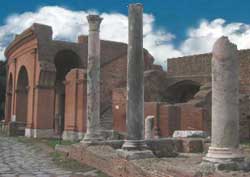
It is the best preserved ancient Roman town. It has superlative mosaics and balconied multi-story buildings.
Top 5 attractions
of Ostia Antica
 Don't miss seeing these
My top-five list:
 Baths of Neptune
Splendid mosaic.
 Piazza of the Corporations
Artistic mosaics visually identify the specialties of dozens of companies (for the multitude who could not read).
 Amphitheatre
Still being used today.
 Forum
Forum
Remains of major temples.
 Fireman's barracks
Ruins of a large fire-unit complex.
Purpose
What functions
did the town serve?
Ostia Antica served as both a military camp (to prevent invaders from sailing up the Tiber River to reach Rome) and the major commercial port for imports from distant lands destined for Rome.
How Pompeii and
Ostia Antica differ
Quick comparison
True, Pompeii is a more exciting tourist draw than Ostia Antica because it was dramatically buried under the ashes of a Vesuvius eruption. However, Ostia Antica has its pluses. It is better preserved and gives the visitor a better idea of what a typical ancient Roman town was like.
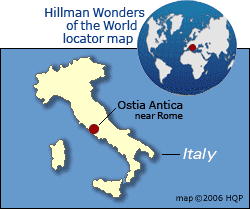
Location in Italy
Learn More
 for Ostia Antica tips - Page 2
Read my other Italy pages
Wonders of Italy - Complete list
Italy wonder map
Basic Italian phrases
Italian cuisine
Best time to visit Rome


World's Top 100 Wonders
World's Top 1000 Wonders
Site map
My credentials
About my website and criteria
Reader testimonials