

Europe

Acropolis/Parthenon
Alhambra
Amalfi Drive
British Museum
Canals of Venice
Cappadocia
Chambord Chateau
Chartres Cathedral
Colosseum of Rome
Delphi
Dubrovnik
Eiffel Tower
Fjords of Norway
Florence Cityscape
Hagia Sophia
Hermitage Museum
Kremlin
Leaning Tower of Pisa
Louvre Museum
Matterhorn
Mezquita of Cordoba
Mont-St-Michel
Neuschwanstein Castle
Pompeii
Portofino
Prague Old Town
Santorini
Sistine Chapel
St. Basil's Cathedral
St. Mark's Basilica
St. Peter's Basilica
Stonehenge
Topkapi Palace
Uffizi Gallery
Versailles

Asia

Angkor Wat
Bagan Temples & Pagodas
Bali
Banaue Rice Terraces
Borobudur
Forbidden City
Golden Pavilion
Golden Temple
Great Wall of China
Hong Kong Harbour/City
Kashmir Valley
Katmandu Valley
Ladakh
Li River Cruise
Lijiang Shargri-La
Meenakshi
Mt. Everest
Potala Palace at Lhasa
Qin Terra Cotta Warriors
Shwedagon Stupa
Taj Mahal
Temple Emerald Buddha
Varanasi/Ganges
Yangtze River Cruise

Africa & Middle East

Abu Simbel
Baalbek
Burj Al Arab
Burj Khalifa
Damascus Old City
Egyptian Museum
Jerusalem Old City
Karnak Temple
Marrakesh
Mecca
Nile River Cruise
Ngorongoro Crater
Petra
Pyramids of Egypt
Sahara Desert
Serengeti Migration
Valley of the Kings
Victoria Falls

North America

Banff National Park
Carlsbad Caverns
Chichen Itza
Grand Canyon
Metropolitan Museum
New York Skyline
Niagara Falls
San Francisco Bay/City
Teotihuacan
Yellowstone
Yosemite

South America

Amazon Rain Forest
Angel Falls
Carnival in Rio
Easter Island
Galapagos Islands
Iguazu Falls
Machu Picchu
Rio Panoramic Views

Other world areas

Antarctica Cruise
Ayers Rock
Bora Bora
Great Barrier Reef

World wonders

Top 100
Top 1000

More

Site map
About me and my credentials
About my website
Reader testimonials
Email me your opinion


Carnival in Rio

candid Brazil tips


Why
Carnival in Rio
is special

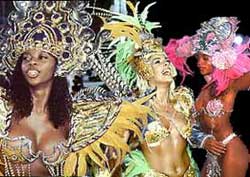
Carnival in Rio has been called the world's most famous party. A million tourists join millions of Rio de Janeiro citizens ("cariocas") in enthusiastic revelry spanning several days.


Carnival of Rio
highlights


Top three

The Sambodromo parade is number one. Close runners-up are the street processions and masquerade balls.


Sambodromo
parade


Statistics

The Sambodromo is a 700-meter (half-mile) long parade strip flanked by spectator stands and luxury boxes. On the last Sunday and Monday nights before Lent, the seats are filled with over 60,000 eager on-lookers. Tickets cost up to hundreds of dollars each and sell out quickly.


Chief attraction

It's the sounds and sights of the parading samba schools that goes on from dusk to day break.


Samba
school defined

A samba school has nothing to do with education. It is typically a group from a poor neighborhood organized to produce a lavish Carnival of Rio procession - for the fun of it.


Selective

Only the best 14 samba schools parade through the big-time Sambodromo (the rest conduct street processions).


Keen Carnival
in Rio competition

Every samba school strives to be judged the best overall.


Slow moving

It can take over an hour for a single samba school to pass a given point along the parade route.


Carnival in Rio floats

Each samba school has showy floats, which are often adorned with sensuous females vibrating to the hypnotic music.


Bands and
singer-dancers

The floats are accompanied by marching samba bands numbering up to 300 musicians - their drummers ceaselessly pound the contagious samba beat. All are escorted by a sea of flamboyantly or scantily clad singer-dancers.


Concerted effort

These diverse parade elements must work as a single unit, dramatizing the same theme, which the samba school changes annually for the Carnival in Rio.


Preparation

A school can have up to 4,000 participants, so melding the ensemble into an organic whole is no easy task. The preparation requires nearly a year of sewing, building, composing, choreographing and rehearsing.


Labor of love

Samba school participants pay for their own costumes, which costs some of them a sizable slice of their income. They willingly do this because Carnival in Rio is a fantasy escape, which helps them forget their hardscrabble lives.


More Carnival in Rio
tips & insights


Street
processions

Some samba schools are not invited to partake in the Sambodromo parade. Many take to the streets. Some parade in their neighborhoods and downtown Rio. Their festivities are free public affairs - passers-by may join the fun by dancing behind (and sometimes with) the group's samba dancers and marching bands. Here you directly participate while in the Sambodromo seats you mainly observe.


Masquerade balls

These are celebrity-attended affairs. The merrymakers wear designer costumes and party from before midnight to the wee hours. It's an exciting and energetic experience (but admission costs up to $200 and the ballrooms tend to be jam-packed). The ball at the Copacabana Palace Hotel is the most famous.


Carnival in Rio
schedules

Carnival in Rio takes place during the days preceding Ash Wednesday, the first of 40 meatless fasting days preceding Easter (Carnival derives from "carne vale" meaning "farewell to meat").

Although the official Carnival in Rio starting day is Saturday, the partying begins in earnest the night before and continues through Tuesday (Mardi Gras means "Fat Tuesday"). 

Here are the Carnival in Rio schedules for the next five years:

2010   Friday Feb 12  Tuesday Feb 16

2011   Friday Mar 4  Tuesday Mar 8

2012   Friday Feb 17  Tuesday Feb 21

2013   Friday Feb 8  Tuesday Feb 12

2014   Friday Feb 28  Tuesday Mar 4


sponsored ad 

Explore my
candid country, region
and other travel guides

Click links for tips & insights


©2010 HQP / Hillman Quality Publications