


Mitla
Travel tips you can trust

Why Mitla
is special
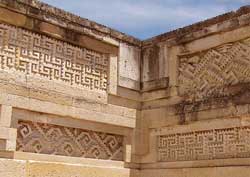
Mitla is famous for the arresting 3-D geometric designs on its building walls (see photo).
About Mitla
 How to pronounce
Mitla: MEET-lah
1800 years old
The Mitla ruins we see today date back to 200 AD and were constructed by the Zapotec civilization (though their successors, the Mixtecs, added some touches).
Religious center
Ancient Mitla was a major religious center. Sometimes the high priest was more powerful than the king.
Columns Group
Best of Mitla
There are five major groups of ruins. Three are essentially rubble. Of the two remaining, the Columns Group is the best preserved and the most visually interesting. The House of Pezelao is its star attraction and my personal favorite.
House of Pezelao
Top 2 tourist draws:
 Friezes
The design of each frieze panel is different from its neighbor's (see photo). This makes the overall collection exceedingly eye-catching.
 Column of Life
According to myth, you will learn how many years you have left by the distance your hands can reach around this large monolith (seems unfair to short people).
Learn More
 for Mitla - Page 2
Learn my other
Mexico tips and insights
Wonders of Mexico
Acapulco
Calakmul
Chichen Itza
Copper Canyon
Mitla
Monte Alban
Natl Mus of Anthropology
Palenque
Parque la Venta
San Miguel de Allende
Taxco
Teotihuacan
Uxmal
Related pages
Mexico wonders - Top 10 rankings
Mexico wonder map
Basic Spanish phrases for travelers
Mexican cuisine

Visit Mexico - Official tourism website

World's Top 100 Wonders
World's Top 1000 Wonders
Site map
My credentials
About my website and criteria
Reader testimonials