


Galapagos
top 5 bird rankings
Cruise tips you can trust
Galapagos birds -
Top 5 rankings
Criteria: Level of interest among sophisticated Galapagos travelers.
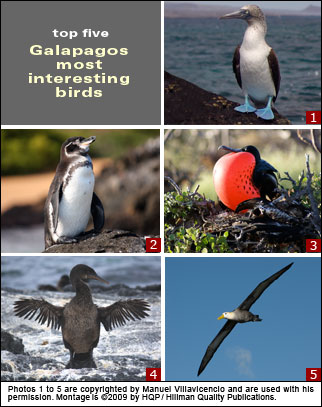
 Blue-footed boobies

 These
Galapagos residents are world famous for their bright blue web feet (see
photo above).
These
Galapagos residents are world famous for their bright blue web feet (see
photo above).
During
the courtship dance, the male blue-footed booby comically raises his feet up and
down, alternating between the two. He's showing off how blue his feet are (the
deeper the blue, the greater the woo).
Blue-footed
boobies catch fish by plunge-diving into very shallow shore water.
This spectacular and seemingly perilous feat captivates visitors.

Most Galapagos islands, but best bets are Espanola, Fernandina, Isabela, and North Seymour.
 Galapagos penguins
This
is one of the world's shortest of penguin species and it
is the only one found north of the equator.
Galapagos
penguins nest in niches in rocky coastal lava cliffs - and spend their
out-of-the-water time living on those protective formations.
Sometimes
these flightless aquatic birds intermingle with snorkelers.
Bartolome (at Pinnacle Rock), Fernandina and Isabel.
 Frigatebird
Males
inflate their bright-red throat pouch (see photo
above) to attract and seduce females.
The
bird was aptly named after the frigate ship, a fast vessel used by pirates.
Reason: The frigatebird hijacks the food of other birds in mid air.
It has
enviable aerial maneuverability despite its broad wingspan.
There
are two main species: Magnificent and Greater.
Genovesa, North Seymour, and San Cristobal.
Click for more bird tips
PAGE TWO for bird rankings # 

MORE BIRDS for
runners-up list



Best Galapagos ships by category
Boat type - pros & cons
Itinerary tips
Cost and booking tips

Best time to go
Getting there tips
Packing tips
Snorkeling tips
Diving tips
Some more helpful tips

Top 5 land & shore wildlife
Top 5 birds
Top 5 marine life

Charles Darwin - Brief bio
Interesting Galapagos facts
Celebrity Xpedition

World's Top 100 Wonders
World's Top 1000 Wonders
Site map
My credentials
About my website and criteria
Reader testimonials